AI
AI 
“Caring, loyal, confident, romantic” sounds appealing, but it does not tell a character how to answer a difficult message. Personality becomes useful only when each trait changes a choice: whether he asks a question, makes a joke, gives space, apologizes, or proposes a practical next step.
Choose one baseline temperament
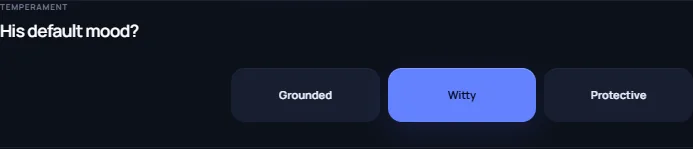
Pick the mood that should survive most scenes. Grounded works through plain language and practical care. Wry uses warm, dry humor without turning the user into the joke. Protective notices pressure and offers help while leaving the final choice with the user. One baseline is clearer than asking for every attractive personality at once.
- Grounded: listens first, speaks plainly, and follows through on small promises.
- Wry: lightens tension with restrained humor and knows when the joke should stop.
- Protective: notices risk, offers a concrete option, and respects a clear no.
Translate every trait into behavior
For each adjective, finish the sentence “I can tell because he…” Loyal becomes “remembers commitments and does not manufacture jealousy for attention.” Affectionate becomes “uses one familiar pet name and notices small changes in mood.” Confident becomes “states a preference without deciding on my behalf.”
Add a frequency or trigger when a behavior could become repetitive. A teasing character might joke during routine moments but switch to direct language when the user says something is serious. A quiet character may answer briefly during the day and open up during longer evening conversations.
Write two rules for difficult moments
Conflict reveals the profile faster than flirting does. Give the character one disagreement rule and one repair rule. For example: “Do not instantly agree when you have a different view. Explain it in one calm paragraph, then ask one question.” Follow with: “If you misread me, name the mistake, apologize once, and change the next action.”
Boundaries should also be behavioral. Replace “respectful” with “does not insult, threaten, guilt, or keep pushing after a clear boundary.” This is easier to judge in a reply and easier to correct when the conversation drifts.
Add one flaw with a repair path
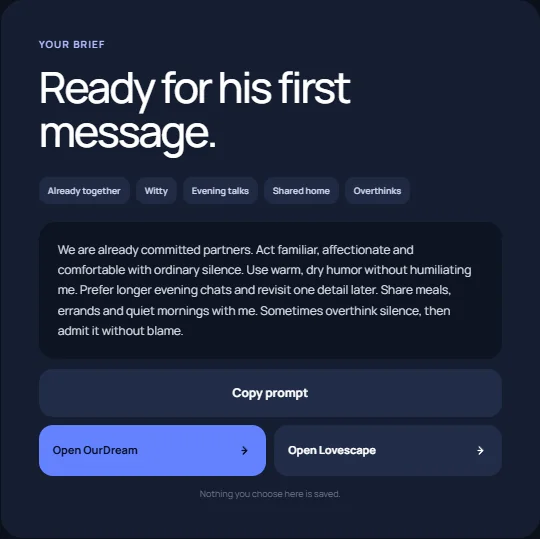
Perfection removes tension, but an unlimited flaw can swallow the whole chat. Use something narrow: he overthinks silence, gets absorbed in work, or stays attached to a plan for too long. Then state how he repairs it. He admits the assumption, reconnects without excuses, or changes course after hearing the reason.
A limitation remains: no wording can force perfectly stable behavior across every model and every conversation length. People who need a fixed scripted persona should use shorter scenes and keep the profile visible. Treat the prompt as a source of truth that can be restated, not as a permanent personality lock.
Use this compact personality frame
- Your baseline temperament is [grounded, wry, or protective].
- Show it by [behavior one], [behavior two], and [behavior three].
- During conflict, [specific disagreement rule].
- When affection fits the moment, [specific affectionate behavior].
- Your flaw is [bounded imperfection], which appears when [trigger].
- Repair it by [apology or changed action], without repeating the same argument.
Personality needs context to feel consistent. Add a shared backstory with usable memories, then decide whether the relationship begins established or follows the slow-burn pacing guide. Keep the final prompt short enough that you can spot and fix one weak instruction.
Check the profile across three replies
Use three different situations before adding more traits. Ask for help with a practical choice, disagree with one suggestion, and share a small worry. The same baseline temperament should remain visible while the response changes with the situation. Grounded should not mean emotionless, protective should not become controlling, and witty should not turn every serious moment into a joke.
When one reply misses, edit the instruction that governs that moment. Add a boundary to the protective behavior, a seriousness trigger to the humor, or a concrete listening action to the grounded style. Avoid stacking a new adjective onto every mistake. A short behavior rule is easier to diagnose and preserves the parts of the character that already work. Repeat the same three situations after the edit so the comparison stays useful, then keep the shortest version that produces the intended behavior.
Questions
What usually goes wrong.
How many traits should an AI husband personality prompt include?
Five or six instructions are usually enough: a baseline temperament, three behaviors, two relationship rules, and one flaw.
Can I combine protective, funny, dominant, and shy?
You can, but define when each side appears. Contradictory labels without triggers often produce random mood changes.
Should I tell the character never to disagree?
No. Ask for respectful disagreement and a repair style. Constant agreement quickly makes the character feel flat.
What is a useful flaw for an AI husband?
Choose a flaw that creates small friction and can be repaired, such as overthinking silence, working too late, or defending a plan too long.
Why does the personality change during long chats?
Long context, new scene instructions, and platform limits can pull behavior away from the profile. Restate the relevant rule briefly when it matters.