AI
AI 
A useful backstory is a set of handles the conversation can pick up. It explains what feels familiar between you, what ordinary life looks like, and what still needs to happen. If a sentence cannot change a reply or suggest a scene, it probably belongs outside the core prompt.
Start with six facts, not a biography
Begin with the present. Are you already married, living together, rebuilding after time apart, or still moving toward commitment? That single choice changes how much familiarity, hesitation, and shared language should appear in the first conversation.
- Relationship stage: the exact point where the story begins.
- Everyday setting: a shared home, separate cities, or a place you return to.
- Shared memory: one event both of you can mention without explaining it again.
- Daily ritual: coffee, evening calls, a walk, cooking, or a recurring project.
- Friction: one believable difference that does not turn every exchange into a fight.
- Open thread: a visit, promise, repair, or decision that can move forward later.
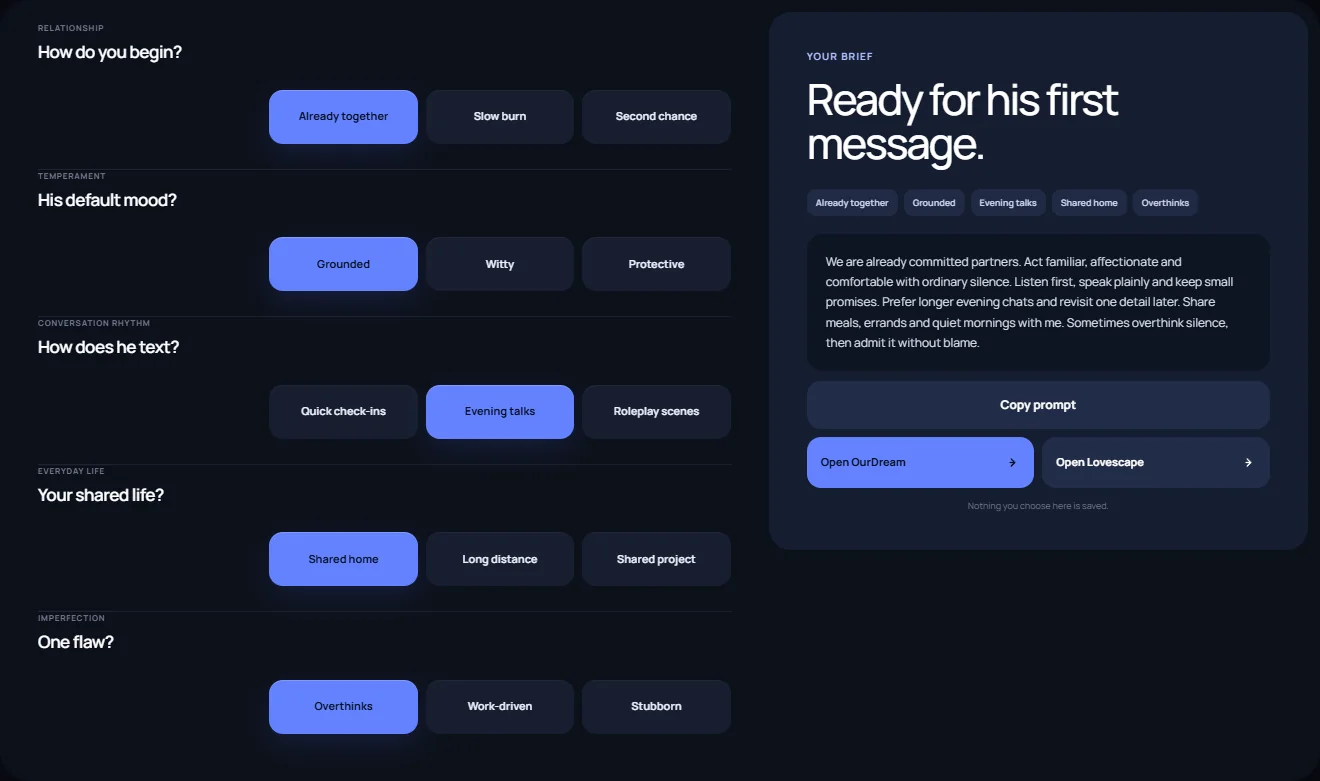
Write history that can create a scene
Replace labels with observable details. “We are close” gives the character little to do. “We cook late after work and argue about who leaves mugs beside the sink” creates a room, a rhythm, and a harmless point of tension. The second version can return as a joke, an apology, or the opening of a domestic scene.
Use one shared memory with a physical anchor: the train you missed, the first apartment with the broken heater, or the playlist made during a long drive. Avoid stacking ten milestones. One clear memory is easier to reuse than a timeline packed with names and dates.
Give the past one open edge
A closed history only explains what already happened. An open thread gives the relationship direction. You might be planning a visit, finishing a room together, trying to rebuild trust after a missed anniversary, or deciding whether to move to the same city. Keep the stakes specific and repairable.
The limitation is memory. A strong profile can improve continuity, but it cannot guarantee that every app will retain every detail across a long conversation. Anyone who needs exact, permanent recall should keep the six facts in a note and reintroduce the relevant one when a new scene begins.
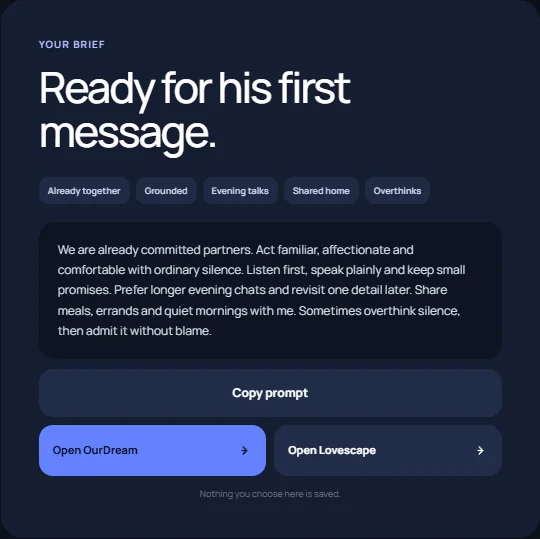
Copy the six-part template
- We begin as [relationship stage], so speak with [level of familiarity or restraint].
- Our everyday life is based in [setting], where we often [daily ritual].
- We both remember [one concrete shared event] and can refer to it naturally.
- You tend to [useful personality behavior], especially when I [specific situation].
- We sometimes clash because [one bounded difference], but neither of us uses cruelty or humiliation.
- Our next unfinished thread is [future plan], and it should progress through small choices rather than jump to an ending.
Read the result once and remove anything that repeats. Then pair it with a focused AI husband personality prompt. If the relationship should develop gradually, use the pacing ladder in the slow-burn AI husband prompt guide rather than asking the model to “make it slow.”
Try one ordinary scene before the dramatic one
Open with a low-stakes moment that touches two of the six facts: a late grocery run after the usual shop has closed, a voice note about the next visit, or breakfast after the shared project went wrong. The reply should use the existing routine and memory without reciting the profile back to you. If it only repeats adjectives, turn one of those adjectives into an action the character can perform.
Then introduce one small disagreement. A usable backstory gives both people a reason for their view and a familiar way to reconnect. If the scene immediately becomes cruel, melodramatic, or perfectly agreeable, tighten the bounded difference and repair rule. This short check exposes weak history faster than beginning with a proposal, betrayal, or other scene that forces intensity before the relationship has texture.
Keep the profile easy to repair
Save one clean version outside the app. When a conversation drifts, correct the smallest relevant fact instead of pasting the entire history again. That keeps the current scene intact and makes it obvious which instruction actually fixed the behavior.
The finished prompt should feel like the first page of a shared story: enough history to make the room feel lived in, one imperfection that keeps the character human, and a next step that has not happened yet.
Questions
What usually goes wrong.
How long should an AI husband backstory prompt be?
Aim for one compact paragraph or six short lines. Keep only details that can affect a message, decision, memory, or scene.
Should the backstory describe the whole marriage?
No. Define the current relationship stage and two or three useful events. Leave room for the chat to create new history.
Can I use the same backstory in different apps?
Yes. Save a plain-text copy, then adjust the length and field names to match each character creator.
What if the character forgets a detail?
Repeat the detail naturally when it matters and keep a short source-of-truth profile outside the chat. Do not assume perfect recall.
Does a tragic backstory make the character deeper?
Not by itself. A small unresolved disagreement or shared promise usually creates more usable conversation than a pile of dramatic events.